

• Skip to main content
  • Skip to header right navigation
  • Skip to after header navigation
  • Skip to site footer
islanddhc
鄰舍輔導會 The Neighbourhood Advice-Action Council

離島地區康健站 Islands DHC Express

  • Font Size
  • 繁
  • 简
Font Size |
  • 繁
  • 简
| Facebook Instagram
  • Home
  • About Us
  • Services
    • Service Scopes
    • Service Flow
    • Service Charge
    • Service Faq
  • Member
  • Health Programme
    • News
    • Featured Activities
    • Event Calendar
  • NSP
    • Network Service Provider List
    • Be a Network Service Provider
  • Health Info
  • Community Resources
    • List of Service Providers
  • Contact Us
  • Join Us
    • Recruitment
    • Volunteer
  • Home
  • About Us
  • Services
    • Service Scopes
    • Service Flow
    • Service Charge
    • Service Faq
  • Member
  • Health Programme
    • News
    • Featured Activities
    • Event Calendar
  • NSP
    • Network Service Provider List
    • Be a Network Service Provider
  • Health Info
  • Community Resources
    • List of Service Providers
  • Contact Us
  • Join Us
    • Recruitment
    • Volunteer

Stroke

2026-08-24

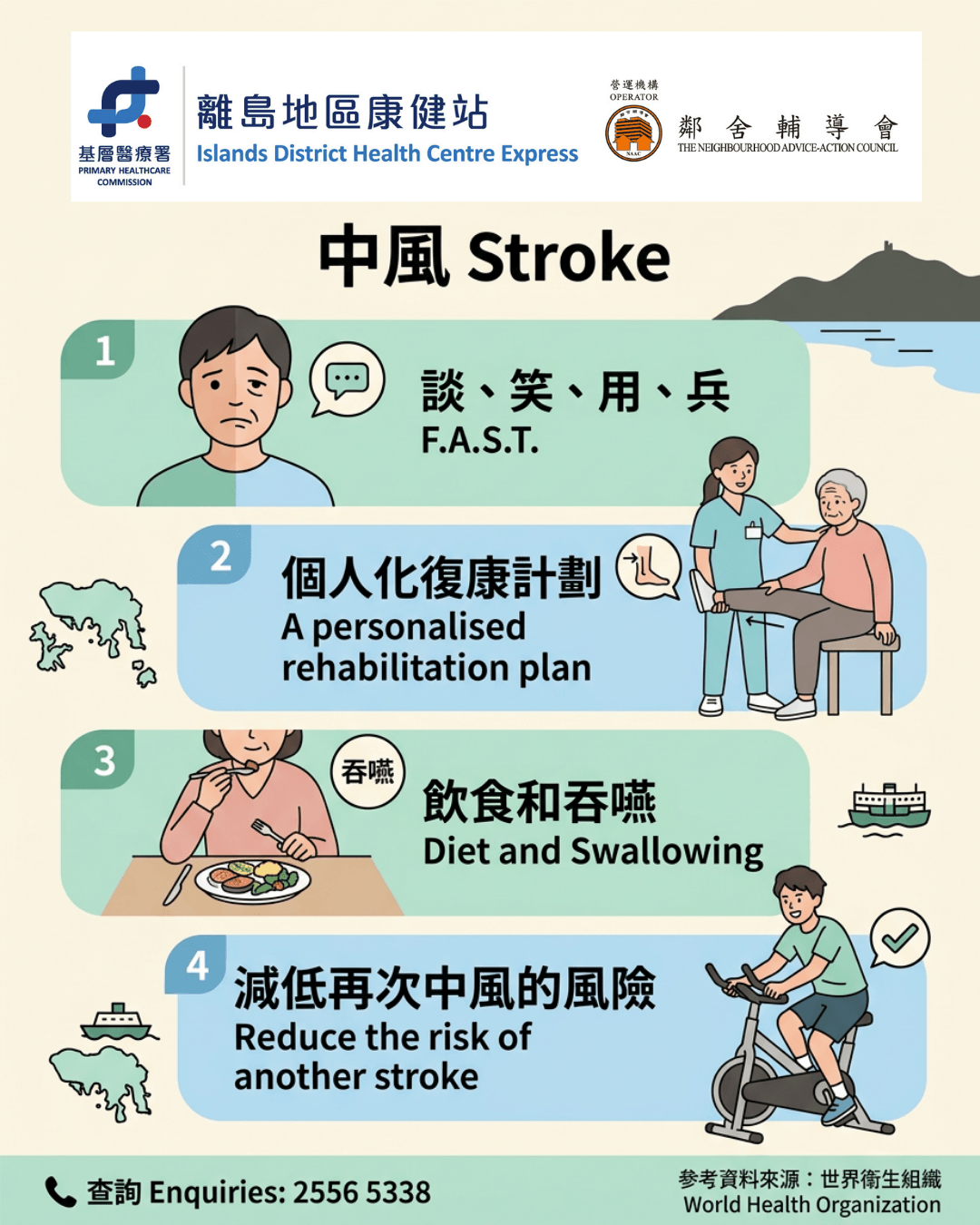
How to recognise a stroke? Remember “FAST”

A stroke is a medical emergency caused by interrupted blood flow to the brain due to a blocked or ruptured blood vessel. Without blood and oxygen, brain cells can be damaged quickly. Early treatment can improve the chance of preserving brain function.

If stroke is suspected, remember FAST:

  • Face: Is one side of the face drooping when smiling?
  • Arms: Is one arm weak or drifting downward when both arms are raised?
  • Speech: Is speech slurred, unclear, or difficult to understand?
  • Time: If any of these signs appear, call 999 for an ambulance immediately.

Other warning signs include sudden loss of balance, severe dizziness, vision loss, numbness or weakness on one side of the body. Even if symptoms disappear within minutes, it may be a transient ischaemic attack (TIA) and requires urgent medical assessment.

Should patients do nothing for recovery after a stroke?

No. Stroke rehabilitation should start as early as possible once the patient is medically stable. A personalised rehabilitation plan should address physical function, swallowing, communication, cognition and emotional needs.

The rehabilitation team may include doctors, nurses, physiotherapists, occupational therapists, speech therapists, dietitians, clinical psychologists and social workers.

Rehabilitation may include:

  • Improving muscle strength, balance, walking and transfer ability
  • Practising daily activities such as dressing, bathing and cooking
  • Managing speech, communication and swallowing difficulties
  • Assessing memory and cognitive function
  • Supporting patients and carers in emotional and daily life adjustment

What should be considered for diet and swallowing?

Some stroke patients may have swallowing difficulties, increasing the risk of choking, aspiration pneumonia, dehydration and malnutrition.

Before a swallowing assessment is completed, patients should not drink, eat or take oral medication by themselves. Food texture and fluid consistency should follow the advice of speech therapists and dietitians. Aspiration pneumonia and swallowing disorders are important post-stroke complications.

How to reduce the risk of another stroke?

Blood pressure control is important for stroke prevention. Quitting smoking, reducing salt intake, staying physically active, managing blood glucose and cholesterol, and taking antiplatelet, anticoagulant or other prescribed medications as directed by a doctor can help reduce risk.

Patients should not stop medication or change the dosage by themselves.

Reference:
World Health Organization. (2025). Stroke: Fact sheet.

Stroke
Previous Post: « Osteoarthritis of the Knee Osteoarthritis of the Knee
Next Post: Hip Fracture Hip Fracture »

Islands DHC ExpressThe Neighbourhood Advice-Action Council

Our Services

    1. Health Promotion Activities
    2. Health Assessment and chronic disease screening & treatment
    3. Disease management

Tel:2556 5338
Email:dhcx@naac.org.hk

About Us
Service Scopes
Service Flow
Service Charge
FAQs
Membership Eligibility
Latest News
Featured Activities

Event Calendar
Network Service Providers List
Be a Network Service Provider
Health Info
List of service organizations
Contact Us
Recruitment
Be a volunteer

                   
Home    Sitemap    Important Notices    Privacy Policy    Accessibility Statement
© 2026 All Rights Reserved
Last Update: 26 Aug 2026
Powered by Marvel Solution

Font Size

After adopting the adaptive web design, you can easily change the font size to suit your personal needs.

Hotkey

If you browse Islands DHC Express (“DHC”) website on a desktop computer, a modern web browser will allow you to hold down the Ctrl key
(Command key on a Macintosh) and press the + or – key to increase or decrease the text size, and 0 to go back to the default size.

On a smartphone or a tablet, you can simply pinch open on the screen to zoom in (i.e. to enlarge) and pinch close to zoom out (i.e. to reduce) everything.

Menu

You may also change the text size from the menu. Choose from the following web browsers for specific instructions:

    • Chrome
      On the Page menu, select Zoom, then Larger.
    • Firefox
      On the View menu, select Zoom, then Zoom In. Or you may click on the Menu icon and select + or – to make the text size bigger or smaller.
    • Internet Explorer / Edge
      On the View menu, select Text Size, then Largest.
      Or you may click on the IE Settings icon, select Zoom, then choose a percentage or click Zoom In.
    • Opera
      On the View menu, select Zoom. Then choose a percentage.
    • Safari
      On the View menu, select Make Text Bigger.

Font Size

After adopting the adaptive web design, you can easily change the font size to suit your personal needs.

Hotkey

When using smartphones and tablets, you can zoom in or out by simply sliding your finger on the screen.