

• Skip to main content
  • Skip to header right navigation
  • Skip to after header navigation
  • Skip to site footer
islanddhc
鄰舍輔導會 The Neighbourhood Advice-Action Council

離島地區康健站 Islands DHC Express

  • Font Size
  • 繁
  • 简
Font Size |
  • 繁
  • 简
| Facebook Instagram
  • Home
  • About Us
  • Services
    • Service Scopes
    • Service Flow
    • Service Charge
    • Service Faq
  • Member
  • Health Programme
    • News
    • Featured Activities
    • Event Calendar
  • NSP
    • Network Service Provider List
    • Be a Network Service Provider
  • Health Info
  • Community Resources
    • List of Service Providers
  • Contact Us
  • Join Us
    • Recruitment
    • Volunteer
  • Home
  • About Us
  • Services
    • Service Scopes
    • Service Flow
    • Service Charge
    • Service Faq
  • Member
  • Health Programme
    • News
    • Featured Activities
    • Event Calendar
  • NSP
    • Network Service Provider List
    • Be a Network Service Provider
  • Health Info
  • Community Resources
    • List of Service Providers
  • Contact Us
  • Join Us
    • Recruitment
    • Volunteer

Osteoarthritis of the Knee

2026-08-20

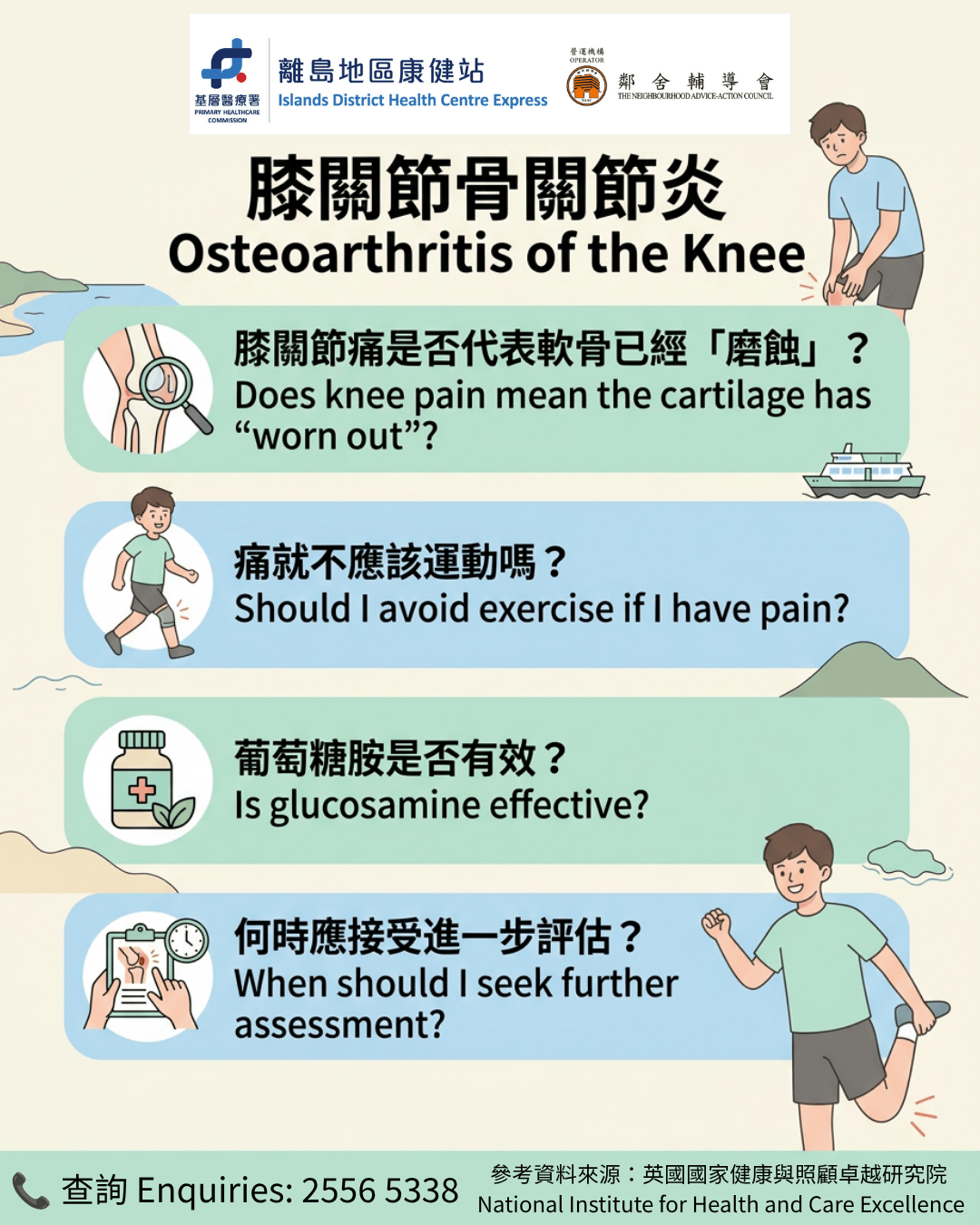
Does knee pain mean the cartilage has “worn out”?

Osteoarthritis of the knee is not only cartilage “wear and tear”. It involves chronic changes of the whole joint. Common symptoms include pain during movement, short morning stiffness, reduced range of motion, and difficulty going up or down stairs or standing up from a chair.

For people aged 45 or above with activity-related joint pain and morning stiffness lasting no more than 30 minutes, osteoarthritis can often be diagnosed based on symptoms and clinical examination. Routine imaging may not be necessary. Treatment should be guided by pain level and functional ability, rather than X-ray findings alone.

Should I avoid exercise if I have pain?

Not necessarily. Appropriate therapeutic exercise is one of the core treatments for knee osteoarthritis. Pain may increase slightly when exercise begins, but with suitable intensity, regular training can help improve muscle strength, joint function and quality of life.

Exercise may include walking, cycling, aquatic exercise, and strengthening exercises for the thigh and hip muscles.

For people who are overweight, gradual weight management can reduce knee loading and may improve pain and mobility. Weight management should combine a balanced diet, physical activity and sustainable lifestyle habits, instead of relying on rapid weight loss methods.

Is glucosamine effective?

Glucosamine is one of the components of cartilage, but research findings are inconsistent. Recent clinical guidelines generally do not regard it as a core treatment for knee osteoarthritis. Patients should not expect it to repair cartilage or bring significant improvement.

People considering glucosamine, especially those who are pregnant, breastfeeding, have diabetes, liver or kidney impairment, shellfish allergy, or are taking anticoagulants, should consult a doctor or pharmacist first. Some supplements may also contain sodium or potassium salts. People who need to restrict sodium or potassium should read product labels carefully.

When should I seek further assessment?

Please seek medical assessment if knee pain continues to worsen, the joint becomes suddenly red, swollen or hot, you cannot bear weight after an injury, or pain severely affects sleep and daily activities.

If exercise, weight management, medication and other non-surgical treatments do not improve severe symptoms, a doctor may consider referral for joint replacement assessment based on individual needs.


Sources:

National Institute for Health and Care Excellence. (2022). Osteoarthritis in over 16s: Diagnosis and management. NICE guideline NG226.

Standardized Care for Diabetes, Hypertension and Lipid Disorders Programme. 葡萄糖胺治療退化性膝關節炎有效嗎?
Osteoarthritis of the Knee
Previous Post: « Low Back Pain Low Back Pain
Next Post: Stroke Stroke »

Islands DHC ExpressThe Neighbourhood Advice-Action Council

Our Services

    1. Health Promotion Activities
    2. Health Assessment and chronic disease screening & treatment
    3. Disease management

Tel:2556 5338
Email:dhcx@naac.org.hk

About Us
Service Scopes
Service Flow
Service Charge
FAQs
Membership Eligibility
Latest News
Featured Activities

Event Calendar
Network Service Providers List
Be a Network Service Provider
Health Info
List of service organizations
Contact Us
Recruitment
Be a volunteer

                   
Home    Sitemap    Important Notices    Privacy Policy    Accessibility Statement
© 2026 All Rights Reserved
Last Update: 26 Aug 2026
Powered by Marvel Solution

Font Size

After adopting the adaptive web design, you can easily change the font size to suit your personal needs.

Hotkey

If you browse Islands DHC Express (“DHC”) website on a desktop computer, a modern web browser will allow you to hold down the Ctrl key
(Command key on a Macintosh) and press the + or – key to increase or decrease the text size, and 0 to go back to the default size.

On a smartphone or a tablet, you can simply pinch open on the screen to zoom in (i.e. to enlarge) and pinch close to zoom out (i.e. to reduce) everything.

Menu

You may also change the text size from the menu. Choose from the following web browsers for specific instructions:

    • Chrome
      On the Page menu, select Zoom, then Larger.
    • Firefox
      On the View menu, select Zoom, then Zoom In. Or you may click on the Menu icon and select + or – to make the text size bigger or smaller.
    • Internet Explorer / Edge
      On the View menu, select Text Size, then Largest.
      Or you may click on the IE Settings icon, select Zoom, then choose a percentage or click Zoom In.
    • Opera
      On the View menu, select Zoom. Then choose a percentage.
    • Safari
      On the View menu, select Make Text Bigger.

Font Size

After adopting the adaptive web design, you can easily change the font size to suit your personal needs.

Hotkey

When using smartphones and tablets, you can zoom in or out by simply sliding your finger on the screen.