

• Skip to main content
  • Skip to header right navigation
  • Skip to after header navigation
  • Skip to site footer
islanddhc
鄰舍輔導會 The Neighbourhood Advice-Action Council

離島地區康健站 Islands DHC Express

  • Font Size
  • 繁
  • 简
Font Size |
  • 繁
  • 简
| Facebook Instagram
  • Home
  • About Us
  • Services
    • Service Scopes
    • Service Flow
    • Service Charge
    • Service Faq
  • Member
  • Health Programme
    • News
    • Featured Activities
    • Event Calendar
  • NSP
    • Network Service Provider List
    • Be a Network Service Provider
  • Health Info
  • Community Resources
    • List of Service Providers
  • Contact Us
  • Join Us
    • Recruitment
    • Volunteer
  • Home
  • About Us
  • Services
    • Service Scopes
    • Service Flow
    • Service Charge
    • Service Faq
  • Member
  • Health Programme
    • News
    • Featured Activities
    • Event Calendar
  • NSP
    • Network Service Provider List
    • Be a Network Service Provider
  • Health Info
  • Community Resources
    • List of Service Providers
  • Contact Us
  • Join Us
    • Recruitment
    • Volunteer

Hip Fracture

2026-08-24

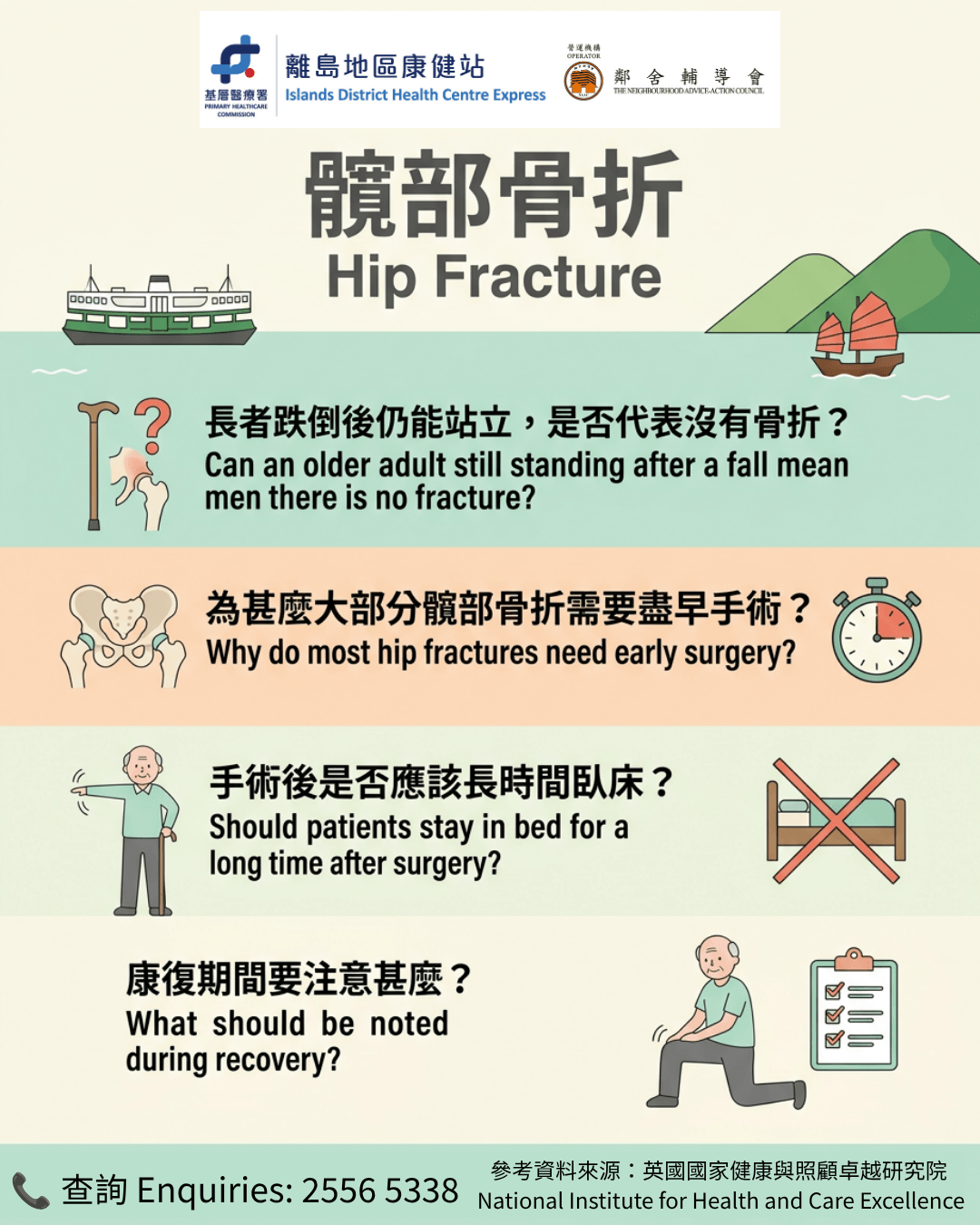
Can an older adult still standing after a fall mean there is no fracture?

Not necessarily. Hip fractures are common among older adults, especially those with osteoporosis, reduced muscle strength or higher fall risk.

Typical symptoms include severe hip or groin pain, the affected leg appearing shortened or externally rotated, and inability to stand or bear weight. However, some people with an incomplete fracture may still manage to stand or walk.

If an older adult has persistent hip pain after a fall, the condition should not be ignored, even if the initial X-ray does not show a fracture. If hip fracture is still clinically suspected, MRI may be considered. If MRI is not available within 24 hours or is unsuitable, CT may be considered.

Why do most hip fractures need early surgery?

The main goals of surgery are to stabilise the fracture, relieve pain and help the patient regain mobility as early as possible.

If the patient is fit for surgery, it should be performed as soon as possible, ideally on the day of or the day after admission. Treatable conditions such as anaemia, dehydration, electrolyte imbalance, heart failure, heart rhythm problems or chest infection should be managed promptly.

Hip fracture care is not limited to orthopaedic surgery. As patients often have other health conditions, a multidisciplinary team should manage pain, nutrition, mobility, cognition, pressure sore risk and discharge planning.

Should patients stay in bed for a long time after surgery?

Generally, prolonged bed rest is not recommended. When the patient’s condition allows, the healthcare team will support early sitting, standing and gradual walking.

Early mobilisation helps restore self-care ability and reduces muscle weakness and other complications related to prolonged bed rest.

What should be noted during recovery?

  • Use walking aids and perform mobility training as advised by physiotherapists.
  • Ensure adequate energy, protein and fluid intake.
  • Assess calcium and vitamin D intake according to individual needs.
  • Check eyesight, footwear, home lighting and trip hazards.
  • Receive assessment for osteoporosis and risk of further fractures.
  • Watch for abnormal signs such as wound problems, persistent fever, shortness of breath, or calf swelling and pain.

Hip fracture may reflect underlying osteoporosis, fall risk or other health issues. Ongoing follow-up after discharge is important, not just waiting for the fracture to heal.

Reference:
National Institute for Health and Care Excellence. (2011, updated 2023). Hip fracture: Management. NICE clinical guideline CG124.

National Institute for Health and Care Excellence. (2011, updated 2023). Hip fracture: Management: Recommendations.

Hip Fracture
Previous Post: « Stroke Stroke
Next Post: Myocardial Infarction Myocardial Infarction »

Islands DHC ExpressThe Neighbourhood Advice-Action Council

Our Services

    1. Health Promotion Activities
    2. Health Assessment and chronic disease screening & treatment
    3. Disease management

Tel:2556 5338
Email:dhcx@naac.org.hk

About Us
Service Scopes
Service Flow
Service Charge
FAQs
Membership Eligibility
Latest News
Featured Activities

Event Calendar
Network Service Providers List
Be a Network Service Provider
Health Info
List of service organizations
Contact Us
Recruitment
Be a volunteer

                   
Home    Sitemap    Important Notices    Privacy Policy    Accessibility Statement
© 2026 All Rights Reserved
Last Update: 26 Aug 2026
Powered by Marvel Solution

Font Size

After adopting the adaptive web design, you can easily change the font size to suit your personal needs.

Hotkey

If you browse Islands DHC Express (“DHC”) website on a desktop computer, a modern web browser will allow you to hold down the Ctrl key
(Command key on a Macintosh) and press the + or – key to increase or decrease the text size, and 0 to go back to the default size.

On a smartphone or a tablet, you can simply pinch open on the screen to zoom in (i.e. to enlarge) and pinch close to zoom out (i.e. to reduce) everything.

Menu

You may also change the text size from the menu. Choose from the following web browsers for specific instructions:

    • Chrome
      On the Page menu, select Zoom, then Larger.
    • Firefox
      On the View menu, select Zoom, then Zoom In. Or you may click on the Menu icon and select + or – to make the text size bigger or smaller.
    • Internet Explorer / Edge
      On the View menu, select Text Size, then Largest.
      Or you may click on the IE Settings icon, select Zoom, then choose a percentage or click Zoom In.
    • Opera
      On the View menu, select Zoom. Then choose a percentage.
    • Safari
      On the View menu, select Make Text Bigger.

Font Size

After adopting the adaptive web design, you can easily change the font size to suit your personal needs.

Hotkey

When using smartphones and tablets, you can zoom in or out by simply sliding your finger on the screen.