

• Skip to main content
  • Skip to header right navigation
  • Skip to after header navigation
  • Skip to site footer
islanddhc
鄰舍輔導會 The Neighbourhood Advice-Action Council

離島地區康健站 Islands DHC Express

  • Font Size
  • 繁
  • 简
Font Size |
  • 繁
  • 简
| Facebook Instagram
  • Home
  • About Us
  • Services
    • Service Scopes
    • Service Flow
    • Service Charge
    • Service Faq
  • Member
  • Health Programme
    • News
    • Featured Activities
    • Event Calendar
  • NSP
    • Network Service Provider List
    • Be a Network Service Provider
  • Health Info
  • Community Resources
    • List of Service Providers
  • Contact Us
  • Join Us
    • Recruitment
    • Volunteer
  • Home
  • About Us
  • Services
    • Service Scopes
    • Service Flow
    • Service Charge
    • Service Faq
  • Member
  • Health Programme
    • News
    • Featured Activities
    • Event Calendar
  • NSP
    • Network Service Provider List
    • Be a Network Service Provider
  • Health Info
  • Community Resources
    • List of Service Providers
  • Contact Us
  • Join Us
    • Recruitment
    • Volunteer

Low Back Pain

2026-08-19
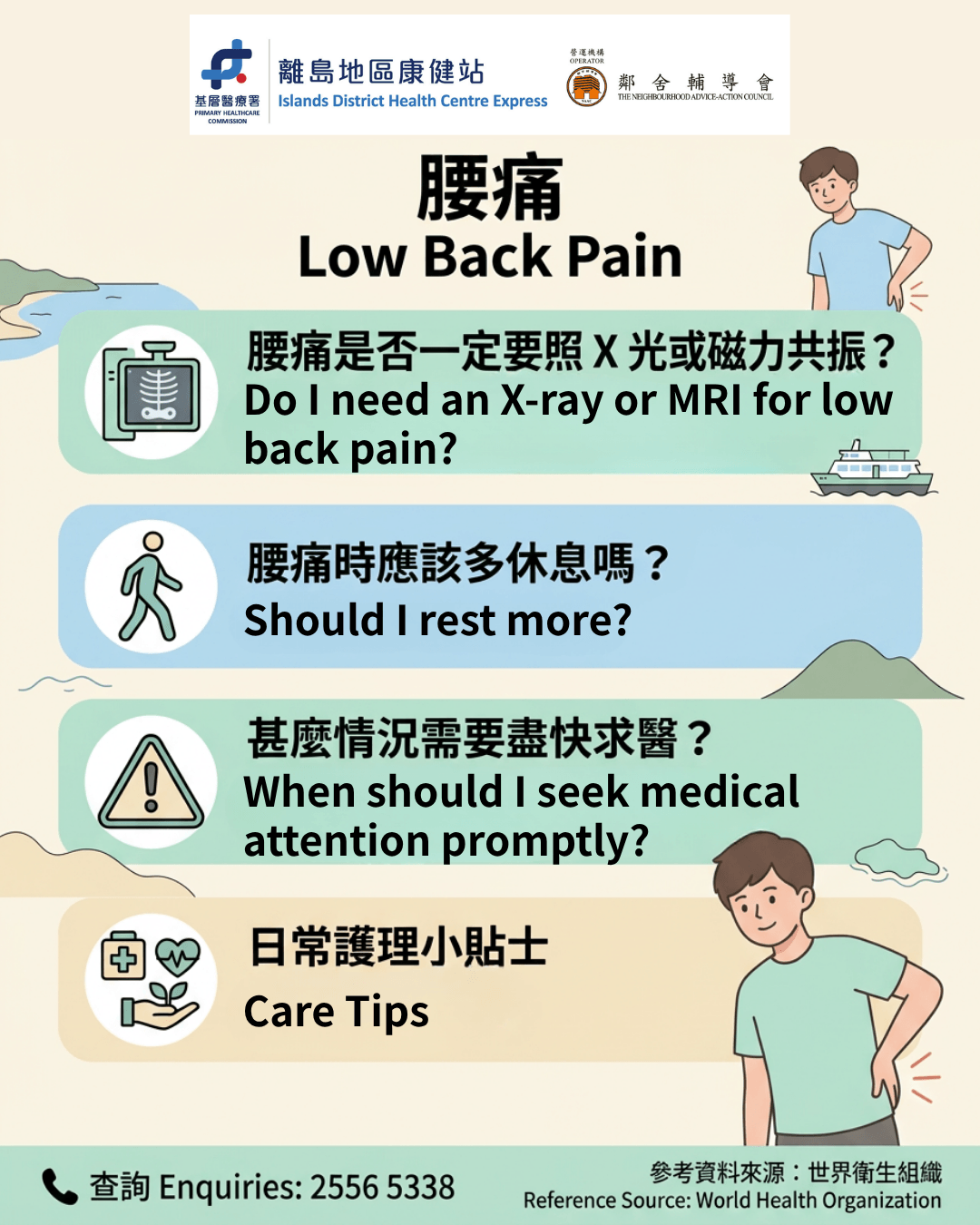
Do I need an X-ray or MRI for low back pain?

Low back pain is very common. According to the World Health Organization, around 90% of cases are non-specific low back pain, meaning no single disease or clear structural injury can fully explain the symptoms.

Most acute low back pain improves gradually. Therefore, X-rays, CT scans or MRI scans are not always needed. Imaging may show disc degeneration, bone spurs or age-related changes, but these may not be the actual cause of pain.

The need for imaging should be assessed by healthcare professionals based on medical history, physical examination and red flags.

Should I rest more when I have low back pain?

It is acceptable to briefly avoid movements that cause severe pain. However, prolonged bed rest may reduce muscle strength, increase joint stiffness and lead to fear of movement.

In general, staying active within tolerance and gradually returning to walking, work and suitable exercise is recommended. Exercise therapy, health education, psychosocial support, sleep improvement and lifestyle modification are important parts of recovery.

Chronic low back pain usually requires comprehensive management, not painkillers, massage or one single treatment alone. WHO recommends a holistic and person-centred approach, taking into account mobility, work environment, sleep, emotions and personal goals.

When should I seek medical attention promptly?

Please seek medical assessment as soon as possible if you have:

  • Low back pain after a serious fall, traffic accident or impact
  • Significant weakness in both legs or rapidly worsening numbness
  • Loss of sensation around the perineum or inner buttocks
  • Sudden loss of bladder or bowel control
  • Low back pain with fever, persistent night pain or unexplained weight loss
  • History of cancer, severe osteoporosis, long-term steroid use or immunosuppression

Daily Care Tips

  1. Stay active within tolerance and avoid prolonged bed rest.
  2. Change posture regularly and take short walks when sitting for long periods.
  3. Gradually strengthen the lower back, abdominal, hip and lower limb muscles.
  4. Maintain a healthy weight, get adequate sleep and avoid smoking.
  5. Seek professional assessment if pain persists, recurs or affects work and sleep.

Source

World Health Organization. (2023). WHO guideline for non-surgical management of chronic primary low back pain in adults in primary and community care settings.
World Health Organization. (2023). WHO guideline for non-surgical management of chronic primary low back pain: Executive summary.
Low Back Pain
Previous Post: « Weight Management Service Weight Management Programme
Next Post: Osteoarthritis of the Knee Osteoarthritis of the Knee »

Islands DHC ExpressThe Neighbourhood Advice-Action Council

Our Services

    1. Health Promotion Activities
    2. Health Assessment and chronic disease screening & treatment
    3. Disease management

Tel:2556 5338
Email:dhcx@naac.org.hk

About Us
Service Scopes
Service Flow
Service Charge
FAQs
Membership Eligibility
Latest News
Featured Activities

Event Calendar
Network Service Providers List
Be a Network Service Provider
Health Info
List of service organizations
Contact Us
Recruitment
Be a volunteer

                   
Home    Sitemap    Important Notices    Privacy Policy    Accessibility Statement
© 2026 All Rights Reserved
Last Update: 26 Aug 2026
Powered by Marvel Solution

Font Size

After adopting the adaptive web design, you can easily change the font size to suit your personal needs.

Hotkey

If you browse Islands DHC Express (“DHC”) website on a desktop computer, a modern web browser will allow you to hold down the Ctrl key
(Command key on a Macintosh) and press the + or – key to increase or decrease the text size, and 0 to go back to the default size.

On a smartphone or a tablet, you can simply pinch open on the screen to zoom in (i.e. to enlarge) and pinch close to zoom out (i.e. to reduce) everything.

Menu

You may also change the text size from the menu. Choose from the following web browsers for specific instructions:

    • Chrome
      On the Page menu, select Zoom, then Larger.
    • Firefox
      On the View menu, select Zoom, then Zoom In. Or you may click on the Menu icon and select + or – to make the text size bigger or smaller.
    • Internet Explorer / Edge
      On the View menu, select Text Size, then Largest.
      Or you may click on the IE Settings icon, select Zoom, then choose a percentage or click Zoom In.
    • Opera
      On the View menu, select Zoom. Then choose a percentage.
    • Safari
      On the View menu, select Make Text Bigger.

Font Size

After adopting the adaptive web design, you can easily change the font size to suit your personal needs.

Hotkey

When using smartphones and tablets, you can zoom in or out by simply sliding your finger on the screen.