

• Skip to main content
  • Skip to header right navigation
  • Skip to after header navigation
  • Skip to site footer
islanddhc
鄰舍輔導會 The Neighbourhood Advice-Action Council

離島地區康健站 Islands DHC Express

  • Font Size
  • 繁
  • 简
Font Size |
  • 繁
  • 简
| Facebook Instagram
  • Home
  • About Us
  • Services
    • Service Scopes
    • Service Flow
    • Service Charge
    • Service Faq
  • Member
  • Health Programme
    • News
    • Featured Activities
    • Event Calendar
  • NSP
    • Network Service Provider List
    • Be a Network Service Provider
  • Health Info
  • Community Resources
    • List of Service Providers
  • Contact Us
  • Join Us
    • Recruitment
    • Volunteer
  • Home
  • About Us
  • Services
    • Service Scopes
    • Service Flow
    • Service Charge
    • Service Faq
  • Member
  • Health Programme
    • News
    • Featured Activities
    • Event Calendar
  • NSP
    • Network Service Provider List
    • Be a Network Service Provider
  • Health Info
  • Community Resources
    • List of Service Providers
  • Contact Us
  • Join Us
    • Recruitment
    • Volunteer

Myocardial Infarction

2026-08-24

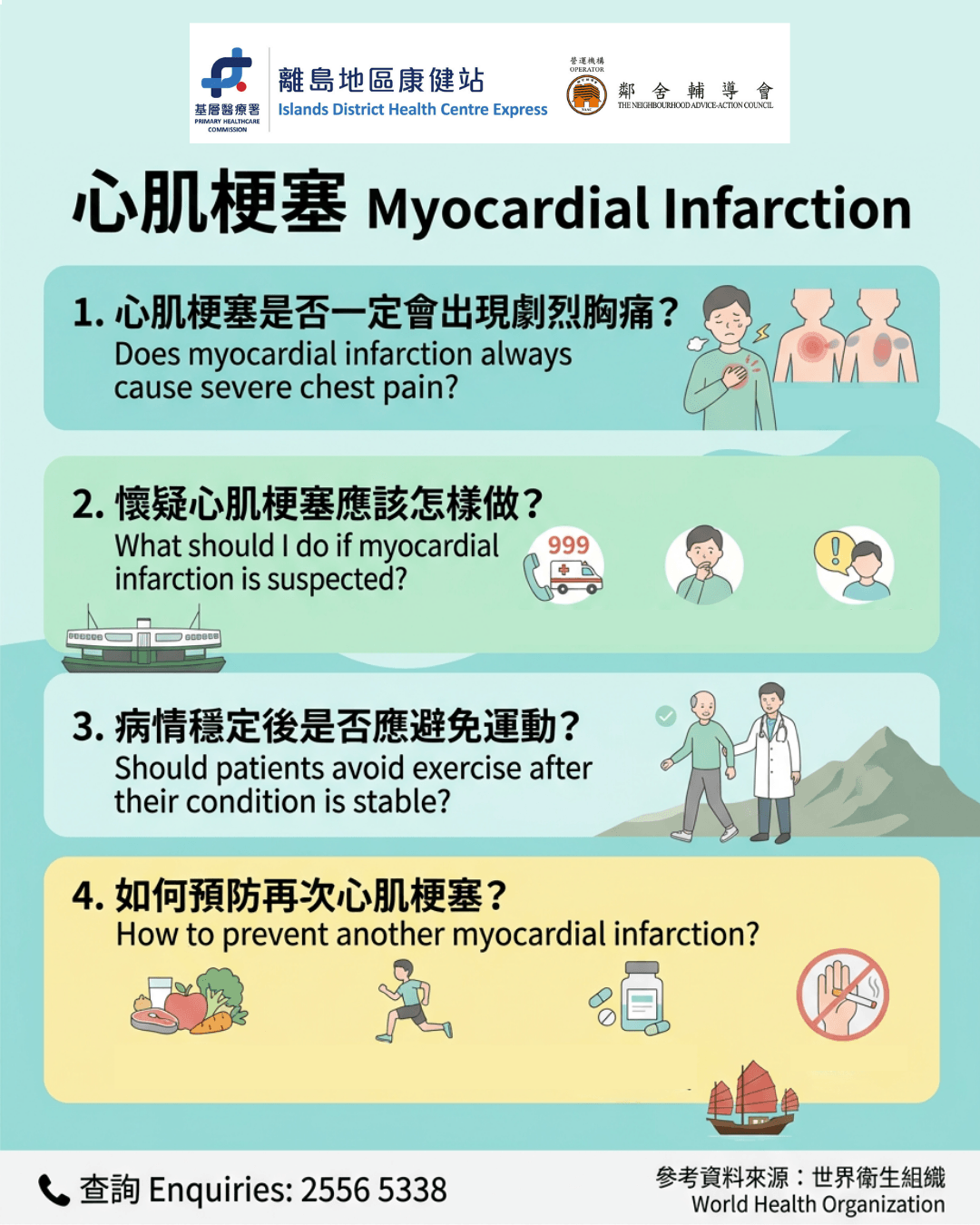
Does myocardial infarction always cause severe chest pain?

Myocardial infarction, commonly known as a “heart attack”, usually occurs when a blood vessel supplying the heart muscle is suddenly blocked, causing part of the heart muscle to become deprived of blood and damaged. Fatty deposits and blood clots in coronary arteries are common underlying causes.

Common symptoms include:

  • Chest pressure, tightness, heaviness or burning sensation
  • Pain spreading to the arm, shoulder, back, neck or jaw
  • Shortness of breath
  • Cold sweat, nausea, dizziness or sudden weakness

Not all patients have typical severe chest pain. Older adults, women and people with diabetes may have less obvious symptoms, such as shortness of breath, tiredness, stomach discomfort or dizziness.

What should I do if myocardial infarction is suspected?

Myocardial infarction is a medical emergency. If chest discomfort persists, recurs, or is accompanied by shortness of breath, sweating, nausea or dizziness, call 999 for an ambulance immediately. Do not drive to hospital by yourself or wait for symptoms to go away.

Do not take another person’s heart medication. Aspirin or prescribed nitroglycerin should only be used as instructed by emergency personnel or healthcare professionals, as some patients may have drug allergy, bleeding risk or other contraindications.

Should patients avoid exercise after their condition is stable?

Not necessarily. After medical assessment, cardiac rehabilitation can support recovery through progressive exercise, health education, psychological support and risk factor management.

Rehabilitation may include inpatient care, early post-discharge support, outpatient training and long-term maintenance.

Exercise intensity should be based on heart function, symptoms, medication and medical advice. Do not start high-intensity exercise by yourself. Stop activity and seek medical assistance if chest pain, unusual shortness of breath, dizziness or palpitations occur.

How to prevent another myocardial infarction?

Key modifiable risk factors include smoking, unhealthy diet, physical inactivity, harmful use of alcohol, high blood pressure, high blood glucose, abnormal blood lipids, and overweight or obesity.

Quitting smoking, having a balanced diet, reducing salt and saturated fat intake, gradually resuming physical activity, and properly managing blood pressure, blood glucose and cholesterol can help reduce risk.

After discharge, take medications as prescribed and attend follow-up appointments. Antiplatelet medicines, cholesterol-lowering medicines and other cardiovascular medications have different roles. Patients should not reduce the dose or stop medication by themselves, even if they feel well.


Reference:
World Health Organization. (2025). Cardiovascular diseases.

Myocardial Infarction
Previous Post: « Hip Fracture Hip Fracture
Next Post: Wellness Enthusiasts: Chronic Disease Co-Care Scheme Pop-up @ Yat Tung Shopping Centre Wellness Enthusiasts: Chronic Disease Co-Care Scheme Pop-up @ Yat Tung Shopping Centre »

Islands DHC ExpressThe Neighbourhood Advice-Action Council

Our Services

    1. Health Promotion Activities
    2. Health Assessment and chronic disease screening & treatment
    3. Disease management

Tel:2556 5338
Email:dhcx@naac.org.hk

About Us
Service Scopes
Service Flow
Service Charge
FAQs
Membership Eligibility
Latest News
Featured Activities

Event Calendar
Network Service Providers List
Be a Network Service Provider
Health Info
List of service organizations
Contact Us
Recruitment
Be a volunteer

                   
Home    Sitemap    Important Notices    Privacy Policy    Accessibility Statement
© 2026 All Rights Reserved
Last Update: 26 Aug 2026
Powered by Marvel Solution

Font Size

After adopting the adaptive web design, you can easily change the font size to suit your personal needs.

Hotkey

If you browse Islands DHC Express (“DHC”) website on a desktop computer, a modern web browser will allow you to hold down the Ctrl key
(Command key on a Macintosh) and press the + or – key to increase or decrease the text size, and 0 to go back to the default size.

On a smartphone or a tablet, you can simply pinch open on the screen to zoom in (i.e. to enlarge) and pinch close to zoom out (i.e. to reduce) everything.

Menu

You may also change the text size from the menu. Choose from the following web browsers for specific instructions:

    • Chrome
      On the Page menu, select Zoom, then Larger.
    • Firefox
      On the View menu, select Zoom, then Zoom In. Or you may click on the Menu icon and select + or – to make the text size bigger or smaller.
    • Internet Explorer / Edge
      On the View menu, select Text Size, then Largest.
      Or you may click on the IE Settings icon, select Zoom, then choose a percentage or click Zoom In.
    • Opera
      On the View menu, select Zoom. Then choose a percentage.
    • Safari
      On the View menu, select Make Text Bigger.

Font Size

After adopting the adaptive web design, you can easily change the font size to suit your personal needs.

Hotkey

When using smartphones and tablets, you can zoom in or out by simply sliding your finger on the screen.