



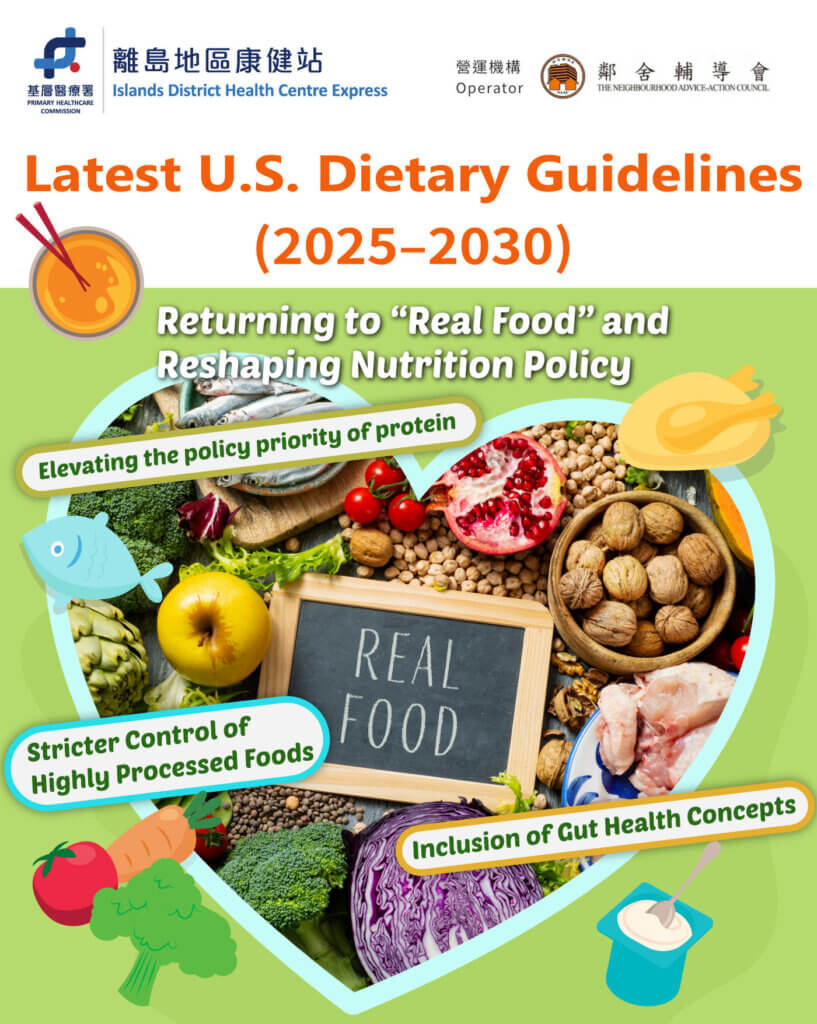
Returning to “Real Food” and Reshaping Nutrition Policy
The U.S. Dietary Guidelines for Americans, 2025–2030 — also known as DGA 2025–2030 — have been officially positioned as the most significant reset of federal nutrition policy in decades. Unlike previous editions, which emphasized “healthy dietary patterns” and calorie control, the new Guidelines greatly simplify the core message to:“Eat Real Food.”
For the first time, the policy also incorporates guidance for infancy and early childhood, emphasizing that nutrition interventions should extend across the entire lifespan. The Guidelines clearly encourage the public to build their diets around whole, nutrient-dense foods that are not highly processed, while sending a strong reform signal to the food industry regarding current processing practices.
1. A Major Shift in Core Nutrition Concepts
Elevating the policy priority of protein:
The new Guidelines introduce, for the first time, a specific body-weight-based recommendation: daily protein intake should be increased to 1.2–1.6 grams per kilogram of body weight. They also support high-quality protein foods from both animal-based and plant-based sources.
Rehabilitating full-fat dairy and natural fats:
Previous Guidelines tended to favor low-fat or fat-free dairy products. The new version clearly supports**“unsweetened full-fat dairy products,”** recognizing their value as sources of high-quality protein and healthy fats.
For cooking fats, in addition to prioritizing olive oil, the Guidelines also list natural fats such as butter and beef tallow as acceptable options, rather than limiting recommendations only to vegetable oils.
2.Stricter Control of Highly Processed Foods and Additives
Clear opposition to highly processed foods:
The new Guidelines directly link highly processed foods with increased chronic disease risk and recommend a substantial reduction in reliance on them.
Stricter limits on sugars and sweeteners:
For added sugars, the recommendation has shifted from the previous limit of less than 10% of total calories to a stricter per-meal limit: no more than 10 grams per meal.
The Guidelines also recommend that children under age 4 completely avoid added sugars, and that children aged 5–10 should also not consume them. In addition, for the first time, the Guidelines explicitly recommend limiting artificial sweeteners such as aspartame, sucralose, and saccharin, in alignment with the FDA’s updated**“healthy” nutrient content claim** rule.
3.First-Time Inclusion of Gut Health Concepts
For the first time, the new Guidelines incorporate the gut microbiome into overall dietary considerations. The Guidelines state that highly processed foods can disrupt the balance of the gut microbiota.
By contrast, fiber-rich vegetables and fruits, as well as fermented foods — such as kimchi, sauerkraut, kefir, and miso — can effectively support a diverse and stable gut microbiota, playing a key role in promoting digestive function and overall immune health.
Islands DHC Express
Enquiries: 2556 5338
Core Centre Address:
Unit B, 2536 Ha Ling Pei, Tung Chung
Next to Tung Chung Fort
Website: islanddhc.org.hk
Opening Hours:
Mon–Thu: 9:00 AM – 6:00 PM
Fri–Sat: 12:00 PM – 9:00 PM
Sun: 9:00 AM – 1:00 PM
Closed on Public Holidays
 Patient Empowerment Program|July–September 2026
 »
»