

• Skip to main content
  • Skip to header right navigation
  • Skip to after header navigation
  • Skip to site footer
islanddhc
鄰舍輔導會 The Neighbourhood Advice-Action Council

離島地區康健站 Islands DHC Express

  • Font Size
  • 繁
  • 简
Font Size |
  • 繁
  • 简
| Facebook
  • Home
  • About Us
  • Services
    • Service Scopes
    • Service Flow
    • Service Charge
    • Service Faq
  • Member
  • Health Act
    • News
    • Featured Activities
    • Event Calendar
  • NSP
    • Network Service Provider List
    • Be a Network Service Provider
  • Health Info
  • Community Info
    • List of Service Providers
  • Contact Us
  • Join Us
    • Recruitment
    • Volunteer
  • Home
  • About Us
  • Services
    • Service Scopes
    • Service Flow
    • Service Charge
    • Service Faq
  • Member
  • Health Act
    • News
    • Featured Activities
    • Event Calendar
  • NSP
    • Network Service Provider List
    • Be a Network Service Provider
  • Health Info
  • Community Info
    • List of Service Providers
  • Contact Us
  • Join Us
    • Recruitment
    • Volunteer

Exercise for Brain Health

Many seniors think of exercise mainly as a way to maintain muscle strength, mobility, and bone health. In fact, regular physical activity is also one of the most natural and effective ways to support brain health and emotional well-being.

Research suggests that exercise may help lower the risk of cognitive decline, while also supporting stress management, sleep quality, and mood regulation.

Here are some recommended activities:

  1. Dual-Task Training

Dual-task training combines physical movement with a mental task. It is a practical way to train balance, concentration, coordination, and cognitive function at the same time.

Choose a safe place to practise, such as a corridor, a park pathway, or any flat, clear, and obstacle-free area.

Start by walking at a comfortable, steady pace. Once you feel stable, add a counting task according to your ability.

Examples:

Basic level:

  • Count from 1 to 100 while walking.

More challenging level:

  • Count upwards by twos: 2, 4, 6, 8…
  • Count backwards by threes: 100, 97, 94…
  • Count in multiples of three: 3, 6, 9…

The aim is to keep walking and counting at the same time, without stopping either activity. Try to maintain a steady walking rhythm and stay focused.

Practising for 5 to 10 minutes per session, once or twice daily, can be beneficial.


  1. Aerobic Exercise

Adults are generally encouraged to take part in at least 150 minutes of moderate-intensity aerobic physical activity per week.

Examples include:

  • Brisk walking
  • Fitness dance
  • Low-impact aerobics
  • Cycling
  • Swimming

Aerobic exercise helps stimulate the release of brain chemicals such as endorphins and serotonin, which are associated with improved mood, reduced anxiety, better sleep, and overall emotional well-being.


  1. Group Exercise

Joining a group exercise class is a great way to stay active while also enjoying social interaction.

Exercising with neighbours, friends, or peers can provide motivation, encouragement, and a greater sense of enjoyment. Regular social participation is also important for maintaining cognitive health and reducing the risk of low mood or depression.

You are welcome to join group exercise classes organised by the centre and take positive steps towards better physical, mental, and brain health.

Islands District Health Centre Express

Enquiry Hotline: 2556 5338

Core Centre Address:
Unit B, 2536 Ha Ling Pei, Tung Chung
Next to Tung Chung Fort

Website: islanddhc.org.hk

Opening Hours:
Monday to Thursday: 9:00 AM – 6:00 PM
Friday to Saturday: 12:00 PM – 9:00 PM
Sunday: 9:00 AM – 1:00 PM
Closed on Public Holidays
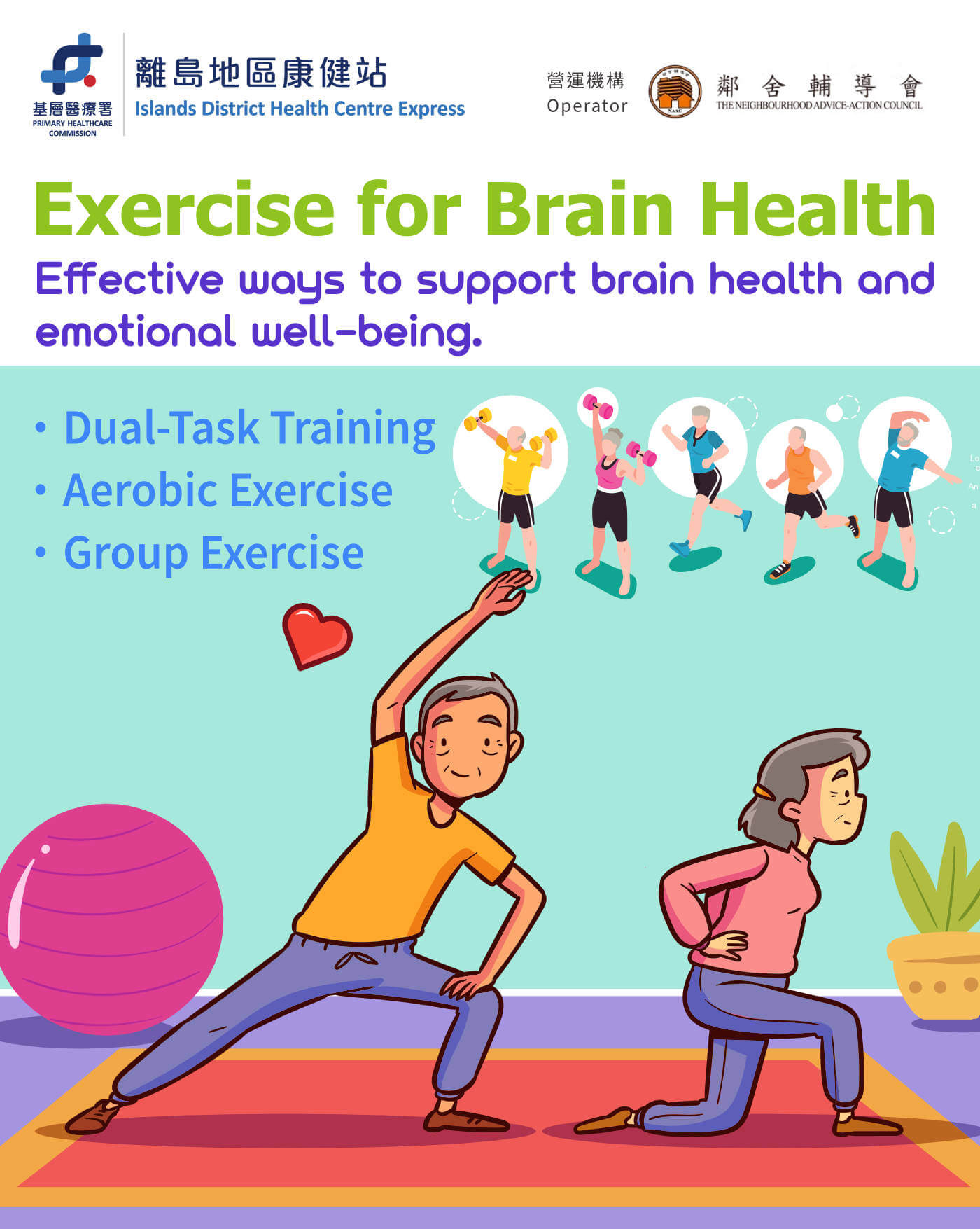
Exercise for Brain Health
Previous Post: « Latest U.S. Dietary Guidelines (2025–2030) Latest U.S. Dietary Guidelines (2025–2030)
Next Post: Summer Tianjiu Service 2026–2027 2026–2027年度夏季三伏天灸服务 »

Islands DHC ExpressThe Neighbourhood Advice-Action Council

Our Services

    1. Health Promotion Activities
    2. Health Assessment and chronic disease screening & treatment
    3. Disease management

Tel:2556 5338
Email:dhcx@naac.org.hk

About Us
Service Scopes
Service Flow
Service Charge
FAQs
Membership Eligibility
Latest News
Featured Activities

Event Calendar
Network Service Providers List
Be a Network Service Provider
Health Info
List of service organizations
Contact Us
Recruitment
Be a volunteer

                   
Sitemap    Disclaimer    Privacy Policy    Copyright    Accessibility Statement
© 2026 All Rights Reserved
Last Update: 14 July 2026

Font Size

After adopting the adaptive web design, you can easily change the font size to suit your personal needs.

Hotkey

If you browse Islands DHC Express (“DHC”) website on a desktop computer, a modern web browser will allow you to hold down the Ctrl key
(Command key on a Macintosh) and press the + or – key to increase or decrease the text size, and 0 to go back to the default size.

On a smartphone or a tablet, you can simply pinch open on the screen to zoom in (i.e. to enlarge) and pinch close to zoom out (i.e. to reduce) everything.

Menu

You may also change the text size from the menu. Choose from the following web browsers for specific instructions:

    • Chrome
      On the Page menu, select Zoom, then Larger.
    • Firefox
      On the View menu, select Zoom, then Zoom In. Or you may click on the Menu icon and select + or – to make the text size bigger or smaller.
    • Internet Explorer / Edge
      On the View menu, select Text Size, then Largest.
      Or you may click on the IE Settings icon, select Zoom, then choose a percentage or click Zoom In.
    • Opera
      On the View menu, select Zoom. Then choose a percentage.
    • Safari
      On the View menu, select Make Text Bigger.

Font Size

After adopting the adaptive web design, you can easily change the font size to suit your personal needs.

Hotkey

When using smartphones and tablets, you can zoom in or out by simply sliding your finger on the screen.